


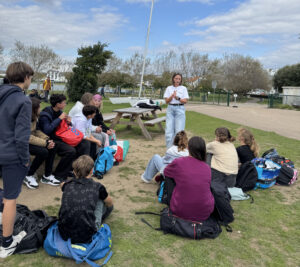
Under a beautiful Breton sky, the students of the nautical section at the Etel middle school kicked off their marine and coastal environmental education project: “My Spot, My Ecosystem.” Led by the Sow my Dream team, this year‑long project will include around ten activities designed to raise awareness among young people about the richness and fragility of their practice area: the Etel ria.
A tool for observation: the biodiversity notebook
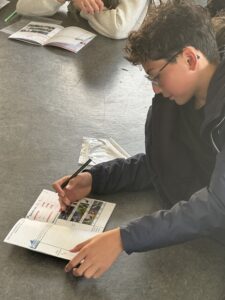
To encourage students to become true observers of their environment, each received an observation notebook to fill in at least once a month. Specially designed for the project, this notebook allows them to record discoveries, draw what they see, and track changes in biodiversity at their nautical spot. It is a valuable tool to reinforce learning and spark curiosity.
A first immersive and collaborative session
For this introductory session, the 64 students from 6th and 5th grade were divided into three groups based on their nautical activity: windsurfing, catamaran, and kayaking. The 6th–5th graders take part in the project on Thursdays, while the 4th–3rd graders follow a similar session on Fridays. The project’s goal: To transform the way they look at their practice “spot,” helping them understand that it is a living ecosystem to observe and protect.
On the programme:
- On land: Presentation of the project’s objectives and creation of a collaborative map of hypotheses about biodiversity and potential threats on site.
- On the water: During their sports session, students were invited to adopt an observer’s mindset and explore ecosystems, biodiversity, human activities, and possible pollution, noting their first observations in their notebooks.
- Back on land: Sharing observations and summarizing the environmental information collected.
This first session aimed to spark students’ curiosity about their immediate environment, create a simple initial inventory of local biodiversity using the notebooks, establish a first overview of the different uses of the sea (fishing, leisure, transport…), and develop an observer’s mindset—essential for becoming active protectors of the coastline.
Jérémie Roger, kayak instructor and teacher in charge of the nautical section, along with Ronan and Yann, the sailing instructors, played a key role in guiding students toward active observation and encouraging them to share their discoveries. The students’ feedback was enthusiastic. Many of them use these places regularly, yet many had never fully realized the richness of the ecosystems or their importance for humans.
What next? This project is part of a long-term approach, with regular sessions throughout the school year—and in the years to come—to deepen knowledge, analyze human impacts, and imagine concrete preservation actions. The students will gradually become true ambassadors of their ecosystem, equipped with their notebooks and field experience.
See you in December to discover the observations collected over the next two months and begin the mapping work!