


This mediation tool aims to help students understand the importance of ecological corridors in a playful way, targeting learners in cycles 3 and 4 (ages 9 to 14). Through a series of puzzles to solve, children must demonstrate cooperation, observation skills, and collective reasoning to discover “what’s going on in the city?”.
Armed with their investigator’s notebook, the children become real researchers on a mission to track down scientific papers that have mysteriously gone missing.

What is ecological connectivity?
An ecological corridor refers to the free movement of animals as they travel and access the areas essential to their life cycle: reproduction, feeding, shelter, and so on. It is based on an ecological network: a system of natural habitats connected to one another. This network includes:
- biodiversity reservoirs, areas rich in species
- linked by ecological corridors, passages connecting natural spaces (hedgerows, rivers, vegetated bridges, etc.)
These continuities are essential for the survival of species, especially in territories that are increasingly fragmented by human activities.
A trial phase that confirms the benefits of learning through play
Through this escape game, the children were able to use puzzles, objects, booklets and so on to discover what can disrupt biodiversity. In the blue section, for example, they were able to observe the need for frogs to reproduce in aquatic environments by putting together a comic strip, or explore the concept of soil permeability in the brown section by handling bottles (see photo below).
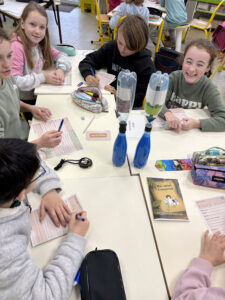
The trial phase provided an opportunity to gather initial feedback from teachers and pupils. The majority of them really enjoyed the topic; they found the puzzles varied and stimulating, and felt they had a good grasp of the concepts covered. This positive feedback reinforces the view that learning through play is an effective way of introducing scientific concepts that can sometimes be complex.
A life-size escape game?
Currently offered indoors, this activity is intended to become an outdoor activity, with the aim of further developing the pupils’ senses and reconnecting them with their environment.
We would like to extend our warmest thanks to the schools that took part in this trial phase for their commitment and valuable feedback, which has been essential in helping us improve this activity.