


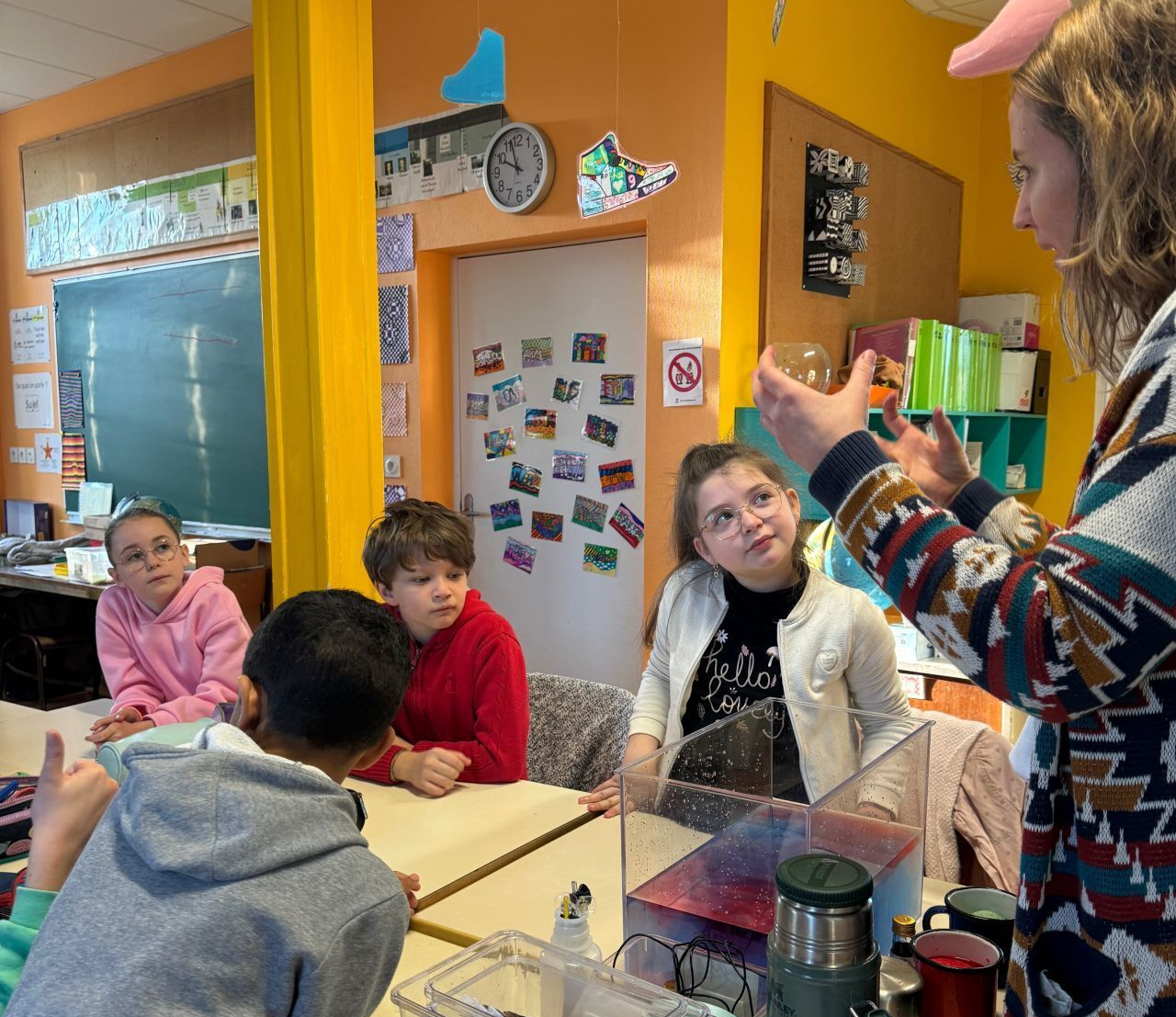
An introduction to spark curiosity
To begin with, the pupils discussed the importance of aquatic environments, those reservoirs of life that are essential to our planet. They also explored concepts related to scientific data, paving the way for a better understanding of ecosystems and their vulnerabilities.
Three interactive workshops to experiment and learn
The workshop was structured around three activities:
The Temperature Odyssey
Using food colouring, hot water and cold water, the pupils observed how ocean currents form. By pouring red-coloured hot water and blue-coloured cold water into a container at the same time, they saw the cold water sink beneath the hot water, recreating a key phenomenon found in aquatic environments. Ocean currents, such as the famous East Australian Current (made famous in *Finding Nemo*), regulate ecosystems and influence the global climate.
Key takeaways:
- Cold water is denser and sinks beneath hot water.
- Temperature differences generate ocean currents, which are essential for the climate balance.
Imaginary cartography
The children drew their ideal body of water, adding features such as landscapes, flora, fauna and human activities. This exercise gave them the opportunity to reflect on the interactions between aquatic ecosystems and human activity, whilst stimulating their creativity.
Key takeaways:
- Water bodies are habitats that are rich in biodiversity but vulnerable.
- Human activities have a direct impact on these ecosystems, which is why it is essential to protect them.
Plankton Race
Working in groups of four or five, the participants made a ‘plankton’ with the aim of getting it to sink as slowly as possible in a container of water. This science activity helped them understand the role of plankton in aquatic environments, by distinguishing between phytoplankton (plant-based) and zooplankton (animal-based).
Workshop instructions:
- The plankton must have been smaller than the palm of a hand.
- It had to be made from at least three different materials.
- The aim was for it to float halfway between the surface and the depths, neither too fast nor on the surface.
Ce qu’on retient :
- Plankton is a microscopic organism that forms the basis of the aquatic food chain.
- All plankton together weigh more than all other aquatic organisms combined!
A free event open to everyone
This free workshop is specially designed for pupils in Years 3 to 6. It combines science, creativity and environmental awareness, enabling children to explore complex concepts whilst having fun.
Would you like your class to have this experience? Get in touch to organise an event!
This workshop is based on our ‘Measure Your Science!’ kit; you can recreate some of the activities by downloading it!
Together, let’s inspire the younger generations to become the champions of biodiversity for tomorrow!