


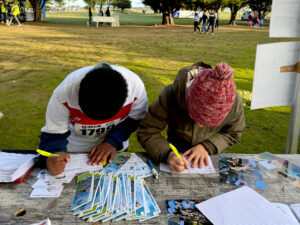
A stand that combines physical activity with environmental awareness
At the Plouharnel site, between races, the pupils were able to stop by our stand to discover, learn and get involved. The aim? To show them that protecting nature can be fun, collaborative and practical.
1. A quiz to test and expand your knowledge
Over 200 pupils took part in our environmental quiz, a simple and effective way of introducing key concepts:
- The foreshore, that area subject to tidal movement where biodiversity is particularly rich.
- Ecosystems, with their abiotic components (water, light, soil) and biotic components (plants, animals).
- Food webs, which illustrate the feeding relationships between species
- Plant reproduction, with terms such as pistil and stamen, which are often unfamiliar but essential for understanding pollination.
The students’ reactions were enthusiastic: some were discovering these concepts for the first time, while others were proud to show what they knew. A way to make science accessible and spark awareness about the importance of protecting natural environments.
2. Two collaborative workshops to get involved together
To take things a step further, we organised two creative and interactive activities:
The Ecomap: Mapping biodiversity and human impacts
The pupils drew on a collaborative map the things that had made an impression on them during the cross-country run:
- Natural features: trees, wetlands, animal species observed.
- Human infrastructure: buildings, roads, signs of pollution. This activity helped to highlight the interactions between humans and nature, and sparked discussions about ways to minimise our impact (e.g. reducing waste, preserving wetlands).
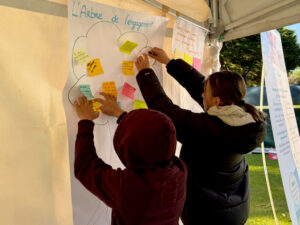
The Commitment Tree: Ideas for Taking Action
On a symbolic tree, the students hung leaves on which they had written their commitments to the planet. Among the most inspiring ideas were:
- ‘I’m going to use a water bottle instead of plastic bottles.’
- ‘I’m going to cycle to school’
- “I’m going to consume less and buy second-hand.” These commitments, which are both personal and collective, show that young people are ready to take action for the environment – they just need to be given the means to do so!
Why raise awareness among young people at a sporting event?
The Departmental Cross-Country Race is an ideal opportunity to reach a wide audience. Sport and environmental education share common values:
- Pushing oneself to the limit, which can also apply to environmental activism.
- Team spirit, essential for carrying out collective actions in favor of biodiversity.
- Developing an awareness of the local area by observing the landscapes encountered during the race.
By combining physical activity with environmental awareness, we have been able to show young people that protecting nature can be part of their daily lives, whether through simple actions or more ambitious projects.
What next?
The Ecomap cards and the Commitment Tree leaves will be shared on our social media in the coming days. We will also use them to support our future workshops and show students that their ideas matter.
Many thanks:
- To the organizers of the Departmental Cross-Country Race for their warm welcome.
- To the teachers and support staff for their support.
- And above all, to the 200 young people who took part with curiosity and enthusiasm!
Together, let’s help grow a generation committed to the planet!